

Updated Jan-2026 Test Engine to Practice Test for CTFL_Syll_4.0 Exam Questions and Answers!
ISTQB Certified Tester Foundation Level (CTFL) v4.0 Certification Sample Questions and Practice Exam
NEW QUESTION # 45
Consider an estimation session where a six-member Agile team (Memb1, ... , Memb6) is performing a planning poker session to estimate a user story (in story points). Team members are using a set of cards with the following values: 1, 2, 3, 5, 8, 13, 21. Below is the outcome produced by the first round of estimation for this session:
Which of the following answers best describes how the estimation session should proceed?
- A. Memb4 and Memb6, which have produced the most pessimistic and the most optimistic estimates respectively, should explain the reasons of their choices to stimulate a discussion between all team members before to proceed to another round of estimation
- B. The final estimate of the user story in story points is determined as the arithmetic mean of all the estimates made by the team members during this first round, without the need to perform further rounds of estimation
- C. The final estimation of the user story in story points is determined as the most frequent estimate value among those selected by the team members (in this case 3 story points chosen by Memb1, Memb2, Memb3, Memb5) during this first round, without the need to perform further rounds of estimation
- D. The final estimate of the user story in story points is determined as the arithmetic mean of the most optimistic estimate (chosen by Memb6) and the most pessimistic estimate (chosen by Memb4) during this first round, without the need to perform further rounds of estimation
Answer: A
Explanation:
In Agile estimation sessions, particularly during Planning Poker, the goal is to reach a consensus on the effort required for a user story. The process encourages discussion and collaboration among team members to understand the story's requirements and complexities fully. Here's a breakdown of the options and why D is the correct choice:
Option A:Calculating the arithmetic mean of all estimates.
* This method is straightforward but does not facilitate team discussion or consensus-building. It merely averages out the estimates without addressing the reasons behind the varying estimates. Thus, important insights and understanding of the task complexity might be missed.
Option B:Selecting the most frequent estimate value.
* While this approach acknowledges the majority's opinion, it ignores the minority views, which might highlight significant aspects of the story that need consideration. It doesn't ensure that all perspectives are considered and discussed.
Option C:Calculating the mean of the most optimistic and pessimistic estimates.
* This approach considers the extremes but again lacks the team discussion and consensus aspect. It also assumes that the extreme values alone can balance out the estimate, which might not always capture the true complexity or simplicity of the task.
Option D:Discussing the most pessimistic and optimistic estimates.
* This approach fosters team collaboration and understanding. Memb4 and Memb6 explain their reasoning for the highest and lowest estimates, respectively, which can reveal different perspectives on the task's complexity. This discussion helps the team align their understanding and often leads to a more accurate and agreed-upon estimate in subsequent rounds.
In conclusion, the main goal of Agile estimation techniques like Planning Poker is to encourage team communication and collaboration to ensure that all aspects of the user story are considered. Option D best aligns with this goal by promoting discussion and consensus.
NEW QUESTION # 46
Which ONE of the following options BEST describes the purpose of confirmation testing versus regression testing?
- A. Regression testing and confirmation testing are interchangeable and serve the same purpose.
- B. Confirmation testing ensures the entire system functions as expected, whereas regression testing focuses only on modified components.
- C. Confirmation testing verifies all system requirements, while regression testing ensures that no additional test cases are needed.
- D. The purpose of confirmation testing is to confirm that the defect giving rise to a failure has been successfully fixed. The regression test aims to ensure that no defects have been introduced or discovered in unmodified areas of the software as a result of the changes made.
Answer: D
Explanation:
Confirmation testingis performed after a defect is fixed to confirm it no longer exists (A).Regression testing ensures new defects have not been introduced in unchanged parts of the system. Regression testing is broader than confirmation testing and covers unmodified areas affected by the changes. Options B, C, and D misrepresent the relationship and scope of these tests.
NEW QUESTION # 47
You are testing a room upgrade system for a hotel. The system accepts three differed types of room (increasing order of luxury): Platinum. Silver and Gold Luxury. ONLY a Preferred Guest Card holder s eligible for an upgrade.
Below you can find the decision table defining the upgrade eligibility:
What is the expected result for each of the following test cases?
Customer A: Preference Guest Card holder, holding a Silver room
Customer B: Non Preferred Guest Card holder, holding a Platinum room
- A. Customer A: offers upgrade to Gold Luxury room; Customer B: doesn't offer any upgrade
- B. Customer A: doesn't offer any upgrade; Customer B: doesn't offer any upgrade.
- C. Customer A: offers upgrade to Silver room; Customer B: offers upgrade to Silver room.
- D. Customer A; doesn't offer any upgrade; Customer B: offers upgrade to Gold luxury room
Answer: A
Explanation:
According to the decision table in the image, a Preferred Guest Card holder with a Silver room is eligible for an upgrade to Gold Luxury (YES), while a non-Preferred Guest Card holder, regardless of room type, is not eligible for any upgrade (NO). Therefore, Customer A (a Preferred Guest Card holder with a Silver room) would be offered an upgrade to Gold Luxury, and Customer B (a non-Preferred Guest Card holder with a Platinum room) would not be offered any upgrade. References = The answer is derived directly from the decision table provided in the image; specific ISTQB Certified Tester Foundation Level (CTFL) v4.0 documents are not referenced.
NEW QUESTION # 48
A test status report should:
- A. specify the impediments to carrying out the planned test activities in the reporting period and the corresponding solutions put in place to remove them
- B. specify the lines of communication between testing, other lifecycle activities, and within the organization that were chosen at the outset of the test project
- C. always be based on the same template within an organization, as its structure and contents should not be affected by the audience to which the report is presented
- D. be produced as part of test completion activities and report unmitigated product risks to support the decision whether or not to release the product
Answer: A
Explanation:
A test status report communicates the current status, progress, and issues encountered during testing to stakeholders. It is crucial for effective test management and decision-making.
* Option A:Correct as it involves reporting impediments and solutions, which are essential for ongoing test activities.
* Option B:Incorrect because test status reports are not limited to test completion activities and focus more on ongoing test status rather than final unmitigated risks.
* Option C:Incorrect as the structure and contents of reports should be tailored to the audience's needs to ensure effective communication.
* Option D:Incorrect because specifying communication lines is typically done in the test plan, not the status report.
Thus, option A best describes a key aspect of a test status report.
NEW QUESTION # 49
Consider the following simplified version of a state transition diagram that specifies the behavior of a video poker game: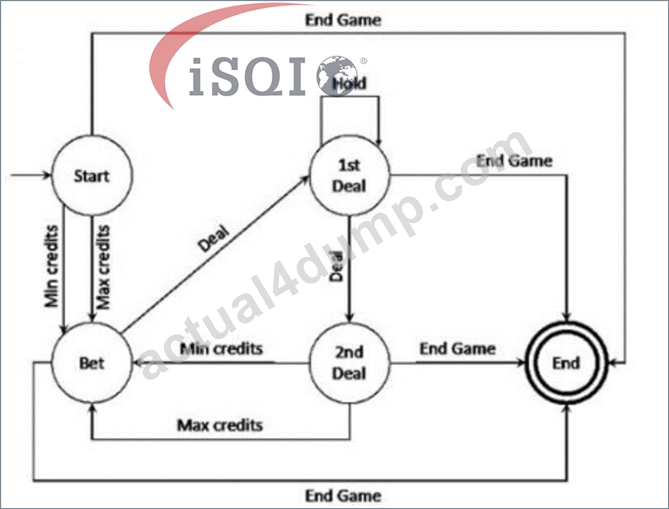
What Is the minimum number of test cases needed to cover every unique sequence of up to 3 states/2 transitions starting In the "Start" state and ending In the "End" state?
- A. 0
- B. 1
- C. 2
- D. 3
Answer: B
Explanation:
Explanation
The minimum number of test cases needed to cover every unique sequence of up to 3 states/2 transitions starting in the "Start" state and ending in the "End" state is 4. This is because there are 4 unique sequences of up to 3 states/2 transitions starting in the "Start" state and ending in the "End" state:
Start -> Bet -> End
Start -> Deal -> End
Start -> 1st Deal -> End
Start -> 2nd Deal -> End References: ISTQB Certified Tester Foundation Level (CTFL) v4.0 sources and documents.
NEW QUESTION # 50
Which of the following statements about checklist-based testing is true?
- A. Checklist-based testing is a review technique that can be used in a formal review process where reviewers, during individual review, try to detect issues within the work product based on a checklist
- B. Checklists used in checklist-based testing should be reviewed periodically for updates as, over time, test cases designed using the same checklist may become less effective at finding defects
- C. In checklist-based testing, using checklists at a high level of detail is more likely to produce test cases that are easier to reproduce than those using checklists at a low level of detail
- D. Checklist-based testing is a technique for managing the review meeting that can be applied in those reviews where the use of checklists is mandatory, as is often the case in formal reviews
Answer: A
Explanation:
Checklist-based testing, as defined in the ISTQB CTFL syllabus, is indeed a review technique used within formal review processes. During these reviews, reviewers individually inspect work products to identify defects based on predefined checklists. These checklists serve as guidelines to ensure thorough examination and to cover important aspects consistently.
The other options do not accurately describe the checklist-based testing technique. Option A describes a technique for managing review meetings rather than the checklist-based testing itself. Option C incorrectly emphasizes the level of detail in checklists as a factor in reproducibility of test cases, which is not the primary focus of checklist-based testing. Option D, while true about the necessity of periodic review, is not the core aspect of the checklist-based testing technique itself.
NEW QUESTION # 51
In which of the following test documents would you expect to find test exit criteria described9
- A. Test design specification
- B. Project plan
- C. Test plan
- D. Requirements specification
Answer: C
Explanation:
Test exit criteria are the conditions that must be fulfilled before concluding a particular testing phase. These criteria act as a checkpoint to assess whether we have achieved the testing objectives and are done with testing1. Test exit criteria are typically defined in the test plan document, which is one of the outputs of the test planning phase. The test plan document describes the scope, approach, resources, and schedule of the testing activities. It also identifies the test items, the features to be tested, the testing tasks, the risks, and the test deliverables2. According to the ISTQB Certified Tester Foundation Level Syllabus v4.0, the test plan document should include the following information related to the test exit criteria3:
* The criteria for evaluating test completion, such as the percentage of test cases executed, the percentage of test coverage achieved, the number and severity of defects found and fixed, the quality and reliability of the software product, and the stakeholder satisfaction.
* The criteria for evaluating test process improvement, such as the adherence to the test strategy, the efficiency and effectiveness of the testing activities, the lessons learned and best practices identified, and the recommendations for future improvements.
Therefore, the test plan document is the most appropriate test document to find the test exit criteria described.
The other options, such as test design specification, project plan, and requirements specification, are not directly related to the test exit criteria. The test design specification describes the test cases and test procedures for a specific test level or test type3. The project plan describes the overall objectives, scope, assumptions, risks, and deliverables of the software project4. The requirements specification describes the functional and non-functional requirements of the software product5. None of these documents specify the conditions for ending the testing process or evaluating the testing outcomes. References = ISTQB Certified Tester Foundation Level Syllabus v4.0, Entry and Exit Criteria in Software Testing | Baeldung on Computer Science, Entry And Exit Criteria In Software Testing - Rishabh Software, Entry and Exit Criteria in Software Testing Life Cycle - STLC [2022 Updated] - Testsigma Blog, ISTQB releases Certified Tester Foundation Level v4.0 (CTFL).
NEW QUESTION # 52
Which of the following statements is true?
- A. Failures can be caused by defects, but also by environmental conditions
- B. A defect may cause a failure which, when occurring, always causes an error
- C. A defect does not always produce a failure, while a bug always produces a failure
- D. Bugs are defects found during component testing, while failures are defects found at higher test levels
Answer: A
Explanation:
Failures can be caused by defects, but also by environmental conditions. A failure is an event in which the software system does not perform a required function or performs a function incorrectly, according to the expected behavior. A defect is a flaw in the software system or a deviation from the requirements or the specifications, that may cause a failure. However, not all failures are caused by defects, as some failures may be caused by environmental conditions, such as hardware malfunctions, network interruptions, power outages, incompatible configurations, etc. Environmental conditions are factors that affect the operation of the software system, but are not part of the software system itself. The other statements are false, because:
* A defect does not always produce a failure, while a bug always produces a failure. This statement is false, because a defect may or may not produce a failure, depending on the inputs, the outputs, the states, or the scenarios of the software system, and a bug is just another term for a defect, so it has the
* same possibility of producing a failure as a defect. For example, a defect in a rarely used feature or a hidden branch of the code may never produce a failure, while a defect in a frequently used feature or a critical path of the code may produce a failure often. A bug is not a different concept from a defect, but rather a synonym or a colloquial term for a defect, so it has the same definition and implications as a defect.
* A defect may cause a failure which, when occurring, always causes an error. This statement is false, because an error is not a consequence of a failure, but rather a cause of a defect. An error is a human action or a mistake that produces a defect in the software system, such as a typo, a logic flaw, a requirement misunderstanding, etc. An error is not observable in the software system, but rather in the human mind or the human work products, such as the code, the design, the documentation, etc. A failure is not a cause of an error, but rather a result of a defect, which is a result of an error. For example, an error in the code may cause a defect in the software system, which may cause a failure in the software behavior.
* Bugs are defects found during component testing, while failures are defects found at higher test levels.
This statement is false, because bugs and failures are not different types of defects, but rather different terms for defects and their manifestations. As mentioned before, bugs are just another word for defects, and failures are the events in which the software system does not perform as expected due to defects.
Bugs and failures can be found at any test level, not only at component testing or higher test levels. Test levels are the stages of testing that correspond to the levels of integration of the software system, such as component testing, integration testing, system testing, and acceptance testing. Defects and failures can occur and be detected at any test level, depending on the test objectives, the test basis, the test techniques, and the test environment. References: ISTQB Certified Tester Foundation Level (CTFL) v4.0 sources and documents:
* ISTQB Certified Tester Foundation Level Syllabus v4.0, Chapter 1.1.2, Testing and Quality1
* ISTQB Certified Tester Foundation Level Syllabus v4.0, Chapter 1.2.1, Testing Principles1
* ISTQB Certified Tester Foundation Level Syllabus v4.0, Chapter 1.3.1, Testing in Software Development Lifecycles1
* ISTQB Glossary of Testing Terms v4.0, Failure, Defect, Bug, Environmental Condition, Error, Test Level2
NEW QUESTION # 53
Which of the following statements refers to good testing practice to be applied regardless of the chosen software development model?
- A. Involvement of testers in work product reviews should occur as early as possible to take advantage of the early testing principle
- B. Tests should be written in executable format before the code is written and should act as executable specifications that drive coding
- C. Test objectives should be the same for all test levels, although the number of tests designed at various levels can vary significantly
- D. Test levels should be defined such that the exit criteria of one level are part of the entry criteria for the next level
Answer: A
Explanation:
The statement that refers to good testing practice to be applied regardless of the chosen software development model is option D, which says that involvement of testers in work product reviews should occur as early as possible to take advantage of the early testing principle. Work product reviews are static testing techniques, in which the work products of the software development process, such as the requirements, the design, the code, the test cases, etc., are examined by one or more reviewers, with or without the author, to identify defects, violations, or improvements. Involvement of testers in work product reviews can provide various benefits for the testing process, such as improving the test quality, the test efficiency, and the test communication. The early testing principle states that testing activities should start as early as possible in the software development lifecycle, and should be performed iteratively and continuously throughout the lifecycle. Applying the early testing principle can help to prevent, detect, and remove defects at an early stage, when they are easier, cheaper, and faster to fix, as well as to reduce the risk, the cost, and the time of the testing process. The other options are not good testing practices to be applied regardless of the chosen software development model, but rather specific testing practices that may or may not be applicable or beneficial for testing, depending on the context and the objectives of the testing activities, such as:
* Tests should be written in executable format before the code is written and should act as executable specifications that drive coding: This is a specific testing practice that is associated with test-driven development, which is an approach to software development and testing, in which the developers write automated unit tests before writing the source code, and then refactor the code until the tests pass. Test- driven development can help to improve the quality, the design, and the maintainability of the code, as well as to provide fast feedback and guidance for the developers. However, test-driven development is not a good testing practice to be applied regardless of the chosen software development model, as it may not be feasible, suitable, or effective for testing in some contexts or situations, such as when the requirements are unclear, unstable, or complex, when the test automation tools or skills are not available or adequate, when the testing objectives or levels are not aligned with the unit testing, etc.
* Test levels should be defined such that the exit criteria of one level are part of the entry criteria for the next level: This is a specific testing practice that is associated with sequential software development models, such as the waterfall model, the V-model, or the W-model, in which the software development and testing activities are performed in a linear and sequential order, with well-defined phases, deliverables, and dependencies. Test levels are the stages of testing that correspond to the levels of integration of the software system, suchas component testing, integration testing, system testing, and acceptance testing. Test levels should have clear and measurable entry criteria and exit criteria, which are the conditions that must be met before starting or finishing a test level. In sequential software development models, the exit criteria of one test level are usually part of the entry criteria for the next test level, to ensure that the software system is ready and stable for the next level of testing. However, this is not a good testing practice to be applied regardless of the chosen software development model, as it may not be relevant, flexible, or efficient for testing in some contexts or situations, such as when the software development and testing activities are performed in an iterative and incremental order, with frequent changes, feedback, and adaptations, as in agile software development models, such as Scrum, Kanban, or XP, when the test levels are not clearly defined or distinguished, or when the test levels are performed in parallel or concurrently, etc.
* Test objectives should be the same for all test levels, although the number of tests designed at various levels can vary significantly: This is a specific testing practice that is associated with uniform software development models, such as the spiral model, the incremental model, or the prototyping model, in which the software development and testing activities are performed in a cyclical and repetitive manner, with similar phases, deliverables, and processes. Test objectives are the goals or the purposes of testing, which can vary depending on the test level, the test type, the test technique, the test environment, the test stakeholder, etc. Test objectives can be defined in terms of the test basis, the test coverage, the test quality, the test risk, the test cost, the test time, etc. Test objectives should be specific, measurable, achievable, relevant, and time-bound, and they should be aligned with the project objectives and the quality characteristics. In uniform software development models, the test objectives may be the same for all test levels, as the testing process is repeated for each cycle or iteration, with similar focus, scope, and perspective of testing. However, this is not a good testing practice to be applied regardless of the chosen software development model, as it may not be appropriate, realistic, or effective for testing in some contexts or situations, such as when the software development and testing activities are performed in a hierarchical and modular manner, with different phases, deliverables, and dependencies, as in sequential software development models, such as the waterfall model, the V-model, or the W-model, when the test objectives vary according to the test levels, such as component testing, integration testing, system testing, and acceptance testing, or when the test objectives change according to the feedback, the learning, or the adaptation of the testing process, as in agile software development models, such as Scrum, Kanban, or XP, etc.References: ISTQB Certified Tester Foundation Level (CTFL) v4.0 sources and documents:
* ISTQB Certified Tester Foundation Level Syllabus v4.0, Chapter 1.1.1, Testing and the Software Development Lifecycle1
* ISTQB Certified Tester Foundation Level Syllabus v4.0, Chapter 1.2.1, Testing Principles1
* ISTQB Certified Tester Foundation Level Syllabus v4.0, Chapter 1.2.2, Testing Policies, Strategies, and Test Approaches1
* ISTQB Certified Tester Foundation Level Syllabus v4.0, Chapter 1.3.1, Testing in Software Development Lifecycles1
* ISTQB Certified Tester Foundation Level Syllabus v4.0, Chapter 2.1.1, Test Planning1
* ISTQB Certified Tester Foundation Level Syllabus v4.0, Chapter 2.1.2, Test Monitoring and Control1
* ISTQB Certified Tester Foundation Level Syllabus v4.0, Chapter 2.1.3, Test Analysis and Design1
* ISTQB Certified Tester Foundation Level Syllabus v4.0, Chapter 2.1.4, Test Implementation1
* ISTQB Certified Tester Foundation Level Syllabus v4.0, Chapter 2.1.5, Test Execution1
* ISTQB Certified Tester Foundation Level Syllabus v4.0, Chapter 2.1.6, Test Closure1
* ISTQB Glossary of Testing Terms v4.0, Work Product Review, Static Testing, Early Testing, Test- driven Development, Test Level, Entry Criterion, Exit Criterion, Test Objective, Test Basis, Test Coverage, Test Quality, Test Risk, Test Cost, Test Time2
NEW QUESTION # 54
Consider the following examples of risks identified in different software development projects:
[I]. The contrast color ratio for both normal text and large text of a website does not comply with the applicable accessibility guidelines, making it difficult for many users to read the content on the pages
[II]. A development vendor fails to deliver their software system on time, causing significant delays to system integration testing activities that have been planned as part of a development project for a system of systems
[III]. People in the test team do not have sufficient skills to automate tests at the test levels required by the test automation strategy which does not allow production of an effective regression test suite
[IV]. In a web application, data from untrusted sources is not subject to proper input validation, making the application vulnerable to several security attacks Which of the following statements is true?
- A. [I] and [IV] are product risks. [II] and [III] are project risks
- B. [I] and [III] are product risks; [II] and [IV] are project risks
- C. [IV] is a product risk; [I]. [II] and [III] are project risks
- D. [II], [III] and [IV] are product risks; [I] is a project risk
Answer: A
Explanation:
This answer is correct because product risks are risks that affect the quality of the software product, such as defects, failures, or non-compliance with requirements or standards. Project risks are risks that affect the project's schedule, budget, resources, or scope, such as delays, cost overruns, skill gaps, or scope changes. In this case, [I] and [IV] are product risks, as they relate to the accessibility and security of the software product, which are quality attributes. [II] and [III] are project risks, as they relate to the delivery time and the test automation skills of the test team, which are project factors. Reference: ISTQB Glossary of Testing Terms v4.0, ISTQB Foundation Level Syllabus v4.0, Section 2.1.1.1
NEW QUESTION # 55
A new web app aims at offering a rich user experience. As a functional tester, you have run some functional tests to verify that, before releasing the app, such app works correctly on several mobile devices, all of which are listed as supported devices within the requirements specification. These tests were performed on stable and isolated test environments where you were the only user interacting with the application. All tests passed, but in some of those tests you observed the following issue: on some mobile devices only, the response time for two web pages containing images was extremely slow.
Based only on the given information, which of the following recommendation would you follow?
- A. The issue is related to performance efficiency, not functionality. Thus, as a functional tester, you should not open any defect report as all the functional tests passed
- B. You should open a defect report providing detailed information on which devices and by running which tests you observed the issue
- C. You should not open any defect report and inform the test manager that the devices on which you observed the issue should no longer be supported so that they will be removed from the requirements specification
- D. You should not open any defect report as the problem is most likely due to poor hardware equipment on the devices where you observed the issue
Answer: B
Explanation:
As a functional tester, you should open a defect report providing detailed information on which devices and by running which tests you observed the issue. A defect report is a document that records the occurrence, nature, and status of a defect detected during testing, and provides information for further investigation and resolution. A defect report should include relevant information such as the defect summary, the defect description, the defect severity, the defect priority, the defect status, the defect origin, the defect category, the defect reproduction steps, the defect screenshots, the defect attachments, etc. Opening a defect report is a good practice for any tester who finds a defect in the software system, regardless of the type or level of testing performed. The other options are not recommended, because:
The issue is related to performance efficiency, not functionality, but that does not mean that as a functional tester, you should not open any defect report as all the functional tests passed. Performance efficiency is a quality characteristic that measures how well the software system performs its functions under stated conditions, such as the response time, the resource utilization, the throughput, etc. Performance efficiency is an important aspect of the user experience, especially for web applications that run on different devices and networks. Even if the functional tests passed, meaning that the software system met the functional requirements, the performance issue observed on some devices could still affect the user satisfaction, the usability, the reliability, and the security of the software system. Therefore, as a functional tester, you have the responsibility to report the performance issue as a defect, and provide as much information as possible to help the developers or the performance testers to investigate and resolve it.
NEW QUESTION # 56
Which ONE of the following options BEST describes a key characteristic of non-functional testing?
- A. Limiting non-functional testing to security testing and performance testing only.
- B. Ensuring non-functional testing focuses only on user experience and usability.
- C. Performing non-functional testing starting at the system test level.
- D. Conducting non-functional testing exclusively at the acceptance test level.
Answer: C
Explanation:
Non-functional testing evaluates attributes like performance, security, and usability, which are typically assessed at thesystem test level or higher(A). It is not restricted to acceptance testing (B), goes beyond security and performance testing (C), and covers more than just user experience (D).
NEW QUESTION # 57
Which ONE of the following options MOST ACCURATELY describesbranch testing?
- A. In branch testing, the coverage items are control flow transfers between decisions, and the aim is to design test cases to exercise flow transfers in the code until an acceptable level of coverage is achieved.
Coverage is measured as the number of branches exercised by the test cases divided by the total number of branches expressed as a percentage. - B. In branch testing, the coverage items are branches, and the aim is to design test cases to exercise branches in the code until an acceptable level of coverage is achieved. Coverage is measured as thenumber of branches exercised by the test cases divided by the total number of branches expressed as a percentage.
- C. In branch testing, the coverage items are executable decisions. The aim is to design test cases that exercise statements in the code until an acceptable level of coverage is achieved. Coverage is expressed as a percentage.
- D. In branch testing, the coverage items are executable statements. The aim is to design test cases that exercise statements in the code until an acceptable level of coverage is achieved, expressed as a percentage.
Answer: B
Explanation:
Branch testingis a structural testing technique that ensures eachbranch (decision point)in the control flow is executed at least once. The goal is to measurebranch coverage, which is the number of branches exercised divided by the total number of branches.
* (A) describes statement testing, not branch testing.
* (B) and (D) introduce confusion between decisions and statements, whereas branch testing focuses on control flow branches.
In simple terms,branch testing checks that all possible decision outcomes (true/false) are executed, whereas statement testing only ensures that each line of code is executed.
NEW QUESTION # 58
Which of the following statements about estimation of the test effort is WRONG?
- A. Experience based estimation is one of the estimation techniques.
- B. Effort estimate can be inaccurate because the quality of the product under tests is not known.
- C. Once the test effort is estimated, resources can be identified and a schedule can be drawn up.
- D. Effort estimate depends on the budget of the project.
Answer: D
Explanation:
Effort estimate does not depend on the budget of the project, but rather on the scope, complexity, and quality of the software product and the testing activities1. Budget is a constraint that may affect the feasibility and accuracy of the effort estimate, but it is not a factor that determines the effort estimate. Effort estimate is the amount of work required to complete the testing activities, measured in terms of person-hours, person-days, or person-months2.
The other options are correct because:
A) Once the test effort is estimated, resources can be identified and a schedule can be drawn up, as they are interrelated aspects of the test planning process3. Resources are the people, tools, equipment, and facilities needed to perform the testing activities4. Schedule is the time frame and sequence of the testing activities, aligned with the project milestones and deadlines5.
B) Effort estimate can be inaccurate because the quality of the product under tests is not known, as it affects the number and severity of the defects that may be found and the rework that may be needed to fix them6. Quality is the degree to which the software product satisfies the specified requirements and meets the needs and expectations of the users and clients7.
D) Experience based estimation is one of the estimation techniques, which relies on the judgment and expertise of the testers and other project stakeholders to estimate the test effort based on similar projects or tasks done in the past. Experience based estimation can be useful when there is a lack of historical data, formal methods, or detailed information about the software product and the testing activities.
Reference =
1 ISTQB® Certified Tester Foundation Level Syllabus v4.0, 2023, p. 154
2 ISTQB® Certified Tester Foundation Level Syllabus v4.0, 2023, p. 155
3 ISTQB® Certified Tester Foundation Level Syllabus v4.0, 2023, p. 156
4 ISTQB® Certified Tester Foundation Level Syllabus v4.0, 2023, p. 157
5 ISTQB® Certified Tester Foundation Level Syllabus v4.0, 2023, p. 158
6 ISTQB® Certified Tester Foundation Level Syllabus v4.0, 2023, p. 159
7 ISTQB® Certified Tester Foundation Level Syllabus v4.0, 2023, p. 16
[8] ISTQB® Certified Tester Foundation Level Syllabus v4.0, 2023, p. 160
[9] ISTQB® Certified Tester Foundation Level Syllabus v4.0, 2023, p. 161
NEW QUESTION # 59
Consider the following table, which contains information about test cases from the test management system: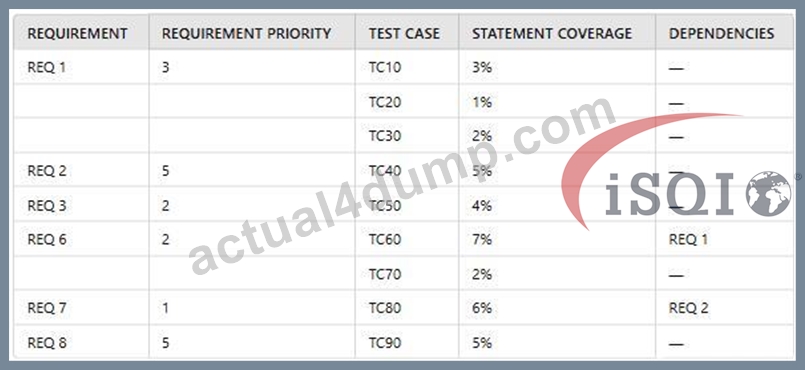
Which ONE of the following optionsorganizes the test cases based on the statement coverage strategy, while considering practical constraints?
- A. {TC 60; TC 80; TC 40; TC 90; TC 50; TC 10; TC 70; TC 30; TC 20}
- B. {TC 20; TC 30; TC 10; TC 40; TC 50; TC 70; TC 60; TC 80; TC 90}
- C. {TC 10; TC 30; TC 20; TC 60; TC 40; TC 80; TC 90; TC 50; TC 70}
- D. {TC 80; TC 70; TC 50; TC 60; TC 20; TC 30; TC 10; TC 40; TC 90}
Answer: A
Explanation:
Statement coverage strategyprioritizestest cases with higher statement coverage first, whileresolving dependenciesbefore execution.
* TC60 (7%)has thehighest coveragebutdepends on REQ 1, so it should be executedafter its dependency is covered.
* TC80 (6%)depends onREQ 2, so it should be prioritizedafter TC40 (REQ 2).
* TC40 (5%)andTC90 (5%)should be executed early.
* Lower coverage test cases (TC10, TC70, TC30, TC20) should come last.
Thus, the correct order is{TC 60; TC 80; TC 40; TC 90; TC 50; TC 10; TC 70; TC 30; TC 20} (D).
Reference:ISTQB CTFL v4.0 Syllabus, Section 4.3 - White-Box Testing Techniques
NEW QUESTION # 60
You are a test manager responsible for implementing risk-based testing in your organization which deals with software in the healthcare domain. You are writing a handbook of various product risk mitigation options.
Which ONE of the following options correctly represent the correct mitigation options?
- A. Using a third party testing company to transfer the risk to that company
- B. Selecting a tester with required knowledge related to compliance and standards
- C. Choosing a tool for automated unit testing to reduce the risks
- D. Increasing the number of testers to be able to take care of all the risks
Answer: B
Explanation:
Selecting a tester with the required knowledge related to compliance and standards is a correct mitigation option, especially in a highly regulated domain like healthcare. This approach ensures that the tester understands the specific regulatory requirements and standards applicable to the software, thereby reducing the risk of non-compliance. This is more effective than just increasing the number of testers, as it directly addresses the knowledge and expertise needed to mitigate specific product risks.
NEW QUESTION # 61
As a tester, as part of a V-model project, you are currently executing some tests aimed at verifying if a mobile app asks the user to grant the proper access permissions during the installation process and after the installation process. The requirements specification states that in both cases the app shall ask the user to grant access permissions only to the camera and photos stored on the device. However, you observe that the app also asks the user to grant access permission to all contacts on the device. Consider the following items:
[I]. Test environment
[II]. Expected result
[III]. Actual result
[IV]. Test level
[V]. Root cause
Based on only the given information, which of the items listed above, are you able to correctly specify in a defect report?
- A. [II]. [Ill] and [V]
- B. [I]. [IV] and [V]
- C. [I]and [IV]
- D. [II]and [III]
Answer: D
Explanation:
In the V-model project described in the question, the tester can identify the following based on the provided information:
* Expected result (II): The requirements specification clearly states that the app should only ask for access permissions to the camera and photos stored on the device during and after installation. This expected behavior is defined by the requirements.
* Actual result (III): The tester observes that the app also requests access to all contacts on the device, which deviates from the expected result. This actual observation can be recorded accurately.
Given these details, the tester can specify the expected result (II) and the actual result (III) in the defect report.
However, without more information, the tester cannot determine the test environment (I), the test level (IV), or the root cause (V).
References:
* ISTQB CTFL Syllabus V4.0, Section 5.5 on Defect Reporting
* Typical contents of a defect report as mentioned in the syllabus include the expected result and the actual result observed during testing.
NEW QUESTION # 62
Which ONE of the following elements is TYPICALLYNOTpart of atest progress report?
- A. Test metrics to show the current status of the test process
- B. A detailed assessment of product quality
- C. New or changed risks
- D. Obstacles and their workarounds
Answer: B
Explanation:
Atest progress reportprovides an overview of testing activities, metrics, and identified risks. It focuses on tracking testing progress rather thanevaluating overall product quality (B), which is typically included in a test summary reportafter testing is completed.
* (A) is correctbecause obstacles (challenges) are reported to ensure test execution stays on track.
* (C) is correctas test metrics help stakeholders track execution progress.
* (D) is correctbecause new or changed risks impact test focus and priorities.
A test progress reporttracks execution and informs stakeholders about ongoing testing activities.
Reference:ISTQB CTFL v4.0 Syllabus, Section 5.3 - Test Monitoring and Control
NEW QUESTION # 63
Which of the following statements about the value of maintaining traceability between the test basis and test work products is not true?
- A. Traceability can be useful for determining how many test basis items are covered by the corresponding tests
- B. Traceability can be useful to support the needs required by the auditing of testing
- C. Traceability can be useful for determining the most suitable test techniques to be used in a testing project
- D. Traceability can be useful for assessing the impact of a change to a test basis item on the corresponding tests
Answer: C
Explanation:
Explanation
Traceability is the ability to trace the relationships between the items of the test basis, such as the requirements, the design, the risks, etc., and the test artifacts, such as the test cases, the test results, the defects, etc. Traceability can provide various benefits for the testing process, such as improving the test coverage, the test quality, the test efficiency, and the test communication. However, not all the statements given are true about the value of maintaining traceability between the test basis and test work products. The statement that is not true is option C, which says that test objectives should be the same for all test levels, although the number of tests designed at various levels can vary significantly. This statement is false, because test objectives are the goals or the purposes of testing, which can vary depending on the test level, the test type, the test technique, the test environment, the test stakeholder, etc. Test objectives can be defined in terms of the test basis, the test coverage, the test quality, the test risk, the test cost, the test time, etc. Test objectives should be specific, measurable, achievable, relevant, and time-bound, and they should be aligned with the project objectives and the quality characteristics. Test objectives should not be the same for all test levels, as different test levels have different focuses, scopes, and perspectives of testing, such as component testing, integration testing, system testing, and acceptance testing. The other statements are true about the value of maintaining traceability between the test basis and test work products, such as:
Traceability can be useful for assessing the impact of a change to a test basis item on the corresponding tests: This statement is true, because traceability can help to identify which tests are affected by a change in the test basis, such as a new requirement, a modified design, a revised risk, etc., and to determine thenecessary actions to update, re-execute, or re-evaluate the tests. Traceability can also help to estimate the effort, the cost, and the time needed to implement the change and to verify its impact on the software system.
Traceability can be useful for determining how many test basis items are covered by the corresponding tests: This statement is true, because traceability can help to measure the test coverage, which is the degree to which the test basis is exercised by the test cases. Traceability can help to identify which test basis items are covered, partially covered, or not covered by the tests, and to evaluate the adequacy, the completeness, and the effectiveness of the testing process. Traceability can also help to identify the gaps, the overlaps, or the redundancies in the test coverage, and to prioritize, optimize, or improve the test cases.
Traceability can be useful to support the needs required by the auditing of testing: This statement is true, because traceability can help to provide evidence, documentation, and justification for the testing activities, results, and outcomes. Traceability can help to demonstrate that the testing process follows the standards, the regulations, the policies, and the best practices that are applicable to the software system, the project, or the organization. Traceability can also help to verify that the testing process meets the expectations, the needs, and the satisfaction of the users and the stakeholders. References: ISTQB Certified Tester Foundation Level (CTFL) v4.0 sources and documents:
ISTQB Certified Tester Foundation Level Syllabus v4.0, Chapter 1.2.2, Testing Policies, Strategies, and Test Approaches1 ISTQB Certified Tester Foundation Level Syllabus v4.0, Chapter 2.1.1, Test Planning1 ISTQB Certified Tester Foundation Level Syllabus v4.0, Chapter 2.1.2, Test Monitoring and Control1 ISTQB Certified Tester Foundation Level Syllabus v4.0, Chapter 2.1.3, Test Analysis and Design1 ISTQB Glossary of Testing Terms v4.0, Traceability, Test Basis, Test Artifact, Test Objective, Test Level, Test Coverage, Test Quality, Test Risk, Test Cost, Test Time2
NEW QUESTION # 64
Scenario 1 "Happy Tomatoes" (used for questions 20-22):
An intelligent application for agricultural use incorporates temperature sensors located at different points of an enclosure. The sensors measure and record the temperature at regular intervals and extract the statistical values for these measurements. These values include the average daily temperature.
A new variety of tomatoes is currently being grown and the"World Organization for Happy Tomatoes"has established temperature ranges related to vegetative development.
When the system establishes that the average temperature is within a specific range, it emits a value that will be used to monitor and control the crop.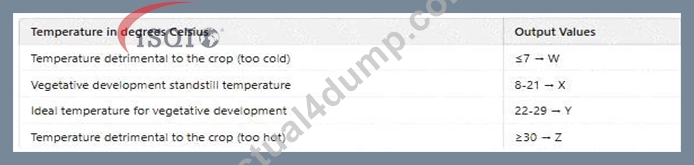
Using theequivalence partitioningtechnique, identify the set of input values that provides the HIGHEST coverage.
- A. {7,10,25,29}
- B. {7,10,25,40}
- C. {7,10,21,40}
- D. {8,10,25,40}
Answer: A
Explanation:
Equivalence partitioning (EP)divides input values into classes where test casesrepresent all possible values of each partition. The partitions in this scenario are:
* #7 (too cold # W)
* 8-21 (standstill # X)
* 22-29 (ideal # Y)
* #30 (too hot # Z)
OptionC ({7,10,25,29})covers all partitionsby selecting representative values:
* 7 # Too cold (W)
* 10 # Standstill (X)
* 25 # Ideal (Y)
* 29 # Upper boundary of ideal (Y)
Other options do not cover all partitions adequately.
NEW QUESTION # 65
Which of the following is an advantage of the whole team approach?
- A. It helps team members understand the current status of an iteration by visualizing the amount of work left to do compared to the time allotted for the iteration
- B. It helps avoid the risk of tasks associated with a user story not moving through the Agile task board at an acceptable rate during an iteration
- C. It helps team members develop better relationships with each other and make their collaboration more effective for the benefit of the project
- D. It helps the whole team be more effective in test case design by requiring all team members to master all types of test techniques
Answer: C
Explanation:
The "whole team approach" in Agile methodologies emphasizes collaboration and communication among all team members, including developers, testers, and business representatives. This approach fosters better relationships and effective collaboration, which ultimately benefits the project by leveraging diverse skills and perspectives. It helps ensure that everyone is aligned with the project's goals and quality standards, thus improving the overall effectiveness and efficiency of the team.
NEW QUESTION # 66
Consider an estimation session where a six-member Agile team (Memb1, ... , Memb6) is performing a planning poker session to estimate a user story (in story points). Team members are using a set of cards with the following values: 1, 2, 3, 5, 8, 13, 21. Below is the outcome produced by the first round of estimation for this session:
Which of the following answers best describes how the estimation session should proceed?
- A. Memb4 and Memb6, which have produced the most pessimistic and the most optimistic estimates respectively, should explain the reasons of their choices to stimulate a discussion between all team members before to proceed to another round of estimation
- B. The final estimate of the user story in story points is determined as the arithmetic mean of all the estimates made by the team members during this first round, without the need to perform further rounds of estimation
- C. The final estimation of the user story in story points is determined as the most frequent estimate value among those selected by the team members (in this case 3 story points chosen by Memb1, Memb2, Memb3, Memb5) during this first round, without the need to perform further rounds of estimation
- D. The final estimate of the user story in story points is determined as the arithmetic mean of the most optimistic estimate (chosen by Memb6) and the most pessimistic estimate (chosen by Memb4) during this first round, without the need to perform further rounds of estimation
Answer: A
Explanation:
In Agile estimation sessions, particularly during Planning Poker, the goal is to reach a consensus on the effort required for a user story. The process encourages discussion and collaboration among team members to understand the story's requirements and complexities fully. Here's a breakdown of the options and why D is the correct choice:
Option A: Calculating the arithmetic mean of all estimates.
* This method is straightforward but does not facilitate team discussion or consensus-building. It merely averages out the estimates without addressing the reasons behind the varying estimates. Thus, important insights and understanding of the task complexity might be missed.
Option B: Selecting the most frequent estimate value.
* While this approach acknowledges the majority's opinion, it ignores the minority views, which might highlight significant aspects of the story that need consideration. It doesn't ensure that all perspectives are considered and discussed.
Option C: Calculating the mean of the most optimistic and pessimistic estimates.
* This approach considers the extremes but again lacks the team discussion and consensus aspect. It also assumes that the extreme values alone can balance out the estimate, which might not always capture the true complexity or simplicity of the task.
Option D: Discussing the most pessimistic and optimistic estimates.
* This approach fosters team collaboration and understanding. Memb4 and Memb6 explain their reasoning for the highest and lowest estimates, respectively, which can reveal different perspectives on the task's complexity. This discussion helps the team align their understanding and often leads to a more accurate and agreed-upon estimate in subsequent rounds.
In conclusion, the main goal of Agile estimation techniques like Planning Poker is to encourage team communication and collaboration to ensure that all aspects of the user story are considered. Option D best aligns with this goal by promoting discussion and consensus.
NEW QUESTION # 67
Who of the following has the best knowledge to decide what tests in a test project should be automated?
- A. The development manager
- B. The test leader
- C. The customer
- D. The developer
Answer: B
Explanation:
The test leader is the person who is responsible for planning, monitoring, and controlling the test activities and resources in a test project. The test leader should have the best knowledge of the test objectives, scope, risks, resources, schedule, and quality criteria. The test leader should also be aware of the test automation criteria, such as the execution frequency, the test support, the team education, the roles and responsibilities, and the devs and testers collaboration1. Based on these factors, the test leader can decide which tests are suitable for automation and which are not, and prioritize them accordingly. The test leader can also coordinate with the test automation engineers, the developers, and the stakeholders to ensure the alignment of the test automation strategy with the test project goals and expectations. References = ISTQB Certified Tester Foundation Level (CTFL) v4.0 Syllabus, Chapter 2, Section 2.3.1, Page 152; ISTQB Glossary of Testing Terms v4.0, Page 403; ISTQB Certified Tester Foundation Level (CTFL) v4.0 Syllabus, Chapter 6, Section 6.1.1, Page 514; Top 8 Test Automation Criteria You Need To Fulfill - QAMIND1
NEW QUESTION # 68
A new web app aims at offering a rich user experience. As a functional tester, you have run some functional tests to verify that, before releasing the app, such app works correctly on several mobile devices, all of which are listed as supported devices within the requirements specification. These tests were performed on stable and isolated test environments where you were the only user interacting with the application. All tests passed, but in some of those tests you observed the following issue: on some mobile devices only, the response time for two web pages containing images was extremely slow.
Based only on the given information, which of the following recommendation would you follow?
- A. The issue is related to performance efficiency, not functionality. Thus, as a functional tester, you should not open any defect report as all the functional tests passed
- B. You should open a defect report providing detailed information on which devices and by running which tests you observed the issue
- C. You should not open any defect report and inform the test manager that the devices on which you observed the issue should no longer be supported so that they will be removed from the requirements specification
- D. You should not open any defect report as the problem is most likely due to poor hardware equipment on the devices where you observed the issue
Answer: B
Explanation:
Explanation
As a functional tester, you should open a defect report providing detailed information on which devices and by running which tests you observed the issue. A defect report is a document that records the occurrence, nature, and status of a defect detected during testing, and provides information for further investigation and resolution.
A defect report should include relevant information such as the defect summary, the defect description, the defect severity, the defect priority, the defect status, the defect origin, the defect category, the defect reproduction steps, the defect screenshots, the defect attachments, etc. Opening a defect report is a good practice for any tester who finds a defect in the software system, regardless of the type or level of testing performed. The other options are not recommended, because:
The issue is related to performance efficiency, not functionality, but that does not mean that as a functional tester, you should not open any defect report as all the functional tests passed. Performance efficiency is a quality characteristic that measures how well the software system performs its functions under stated conditions, such as the response time, the resource utilization, the throughput, etc.
Performance efficiency is an important aspect of the user experience, especially for web applications that run on different devices and networks. Even if the functional tests passed, meaning that the software system met the functional requirements, the performance issue observed on some devices could still affect the user satisfaction, the usability, the reliability, and the security of the software system.
Therefore, as a functional tester, you have the responsibility to report the performance issue as a defect, and provide as much information as possible to help the developers or the performance testers to investigate and resolve it.
NEW QUESTION # 69
......
Certification dumps ISTQB Foundation Level CTFL_Syll_4.0 guides - 100% valid: https://pass4sure.actual4dump.com/ISQI/CTFL_Syll_4.0-actualtests-dumps.html