

[Jun 25, 2026] Get Up-To-Date Real Exam Questions for GES-C01 with New Materials
Updated GES-C01 Certification Exam Sample Questions
NEW QUESTION # 25
A security administrator needs to manage access to Snowflake Cortex LLM functions and models, and ensure compliant usage across different regions for various teams. Which configuration options and parameters are relevant for these requirements?
- A. Option E
- B. Option B
- C. Option C
- D. Option D
- E. Option A
Answer: B,C,E
Explanation:
NEW QUESTION # 26 
Which of the following is a 'direct cause' of this error related to missing schema-level privileges, assuming the model build name is unique and the warehouse is active and accessible?
- A.

- B.

- C.

- D.

- E.

Answer: E
Explanation:
NEW QUESTION # 27
A new ML Engineer, 'data_scientist_role' , has been assigned to a project involving custom machine learning models in Snowflake. They need to gain the necessary permissions to perform the following actions related to Snowflake Model Registry and Snowpark Container Services: 1. Log a custom model into a specified schem a. 2. Deploy that model to an existing Snowpark Container Service compute pool. 3. Call the deployed model for inference using SQL. Which of the following SQL commands grant the 'minimal' required privileges to the for these actions, assuming the compute pool and image repository already exist and are appropriately configured?
- A.

- B.

- C.

- D.

- E.

Answer: A,D
Explanation:
Option A is correct because the 'CREATE MODEL' privilege on the target schema is required to log a new model (which creates a model object) in the Snowflake Model Registry. Option D is correct because deploying a model to a Snowpark Container Service creates a service object within a schema, which requires the 'CREATE SERVICE privilege on that schema. The role would also implicitly need 'USAGE on the specified compute pool. Option B is incorrect. While 'USAGE ON DATABASE is generally needed for accessing objects within a database, it's a broader prerequisite and not specifically a minimal privilege for the direct model registry actions of logging, deploying, and calling the model. Option C is incorrect because 'CREATE COMPUTE POOL' is for creating the compute pool itself, not for deploying a service 'to' an existing one. The role would need 'USAGE' on the existing compute pool, but not the right to create it from scratch for this scenario. Option E is incorrect because 'READ ON IMAGE REPOSITORY is required for the 'service' to pull the image from the repository, but the question asks for privileges for the to perform the 'actions' of logging, deploying, and calling. While the role might need to manage or verify the image, this isn't a direct privilege for the user's interaction with the deployed model in the same way 'CREATE MODEL' or 'CREATE SERVICE are.
NEW QUESTION # 28
A Snowflake administrator is tasked with ensuring that a specific data science team can only use approved LLMs (mistral-7b, llama3.1-8b) for generative AI tasks within a particular schema, and also needs to enable the use of an LLM in a non-native region due to specific project requirements. Which combination of configurations would meet these requirements?
- A. Option E
- B. Option B
- C. Option C
- D. Option D
- E. Option A
Answer: B,E
Explanation:
NEW QUESTION # 29
A financial institution uses Snowflake Cortex LLM functions to process customer feedback. They initially used SNOWF LAKE .CORTEX.SENTIMENT for general sentiment analysis. Now, they need to extract specific sentiment categories (e.g., 'service_quality', 'product_pricing') and the sentiment for each, expecting the output in a structured JSON format for automated downstream processing. Which AI_COMPLETE configuration best addresses their new requirement while considering cost-efficiency and output reliability?
- A.

- B.

- C.

- D.

- E.

Answer: B
Explanation:
Option B is correct. For medium-complexity tasks like extracting specific sentiment categories into a structured format, Snowflake recommends using more powerful models, explicitly prompting the model to 'Respond in JSON', providing detailed descriptions for schema fields, and setting fields as 'required' to improve accuracy and ensure adherence to the schema.
is a smaller model which might struggle with the accuracy and reliability required for complex structured extraction compared to more powerful models, even with a schema. Option C is incorrect because a temperature of 1.0 increases randomness, which is detrimental to the reliability and consistency required for structured JSON output and automated processing. The response_format should also be specified in the options argument explicitly for structured output. Option D is incorrect; while mistral-large2 is a powerful model, relying on guardrails alone does not guarantee structured output or adherence to a specific JSON schema for complex extraction. For complex tasks, explicit prompting and schema details are crucial. Option E is incorrect because
) returns a single classification label and cannot produce a JSON object with multiple specific sentiment categories and their respective sentiments from a single input text as required by the scenario.
NEW QUESTION # 30
An organization is planning to implement a new Retrieval Augmented Generation (RAG) application and has chosen Snowflake Cortex Search as its core retrieval engine. To effectively manage their budget, the finance and data teams need a clear understanding of the various cost components associated with deploying and operating a Cortex Search Service. Which of the following represent distinct cost categories directly attributable to the deployment and ongoing operation of a Snowflake Cortex Search Service?
- A. Virtual warehouse compute used for refreshing the search service's index and processing base object changes.
- B. ' Services compute specifically for generating vector embeddings of text data during the indexing and update processes.
- C. Cloud Services compute for monitoring underlying base objects for changes to trigger search service refreshes.
- D. Compute costs for LLM inference (e.g., SNOWFLAKE.CORTEX.COMPLETE) when the RAG application uses the retrieved context to generate responses.
- E. Storage for the materialized source data and the optimized search index data structures within the Snowflake account.
Answer: A,B,C,E
Explanation:
Virtual warehouse compute is required for refreshing the search service, which includes running queries against base objects, orchestrating text embedding jobs, and building the search index. Storage costs are incurred for the materialized source query into a table and for storing the optimized data structures for low-latency serving (the search index), billed at a flat rate per TB. ' Services compute cost, specifically for EMBED_TEXT_TOKENS, is incurred for generating vector embeddings during the indexing and update process of the search service. Cloud services compute is used by Cortex Search Services to identify changes in underlying base objects, triggering refreshes of the search service. Option B is incorrect because the cost of LLM inference (e.g., using 'SNOWFLAKE.CORTEX.COMPLETE) to generate responses based on retrieved context is a separate cost from the Cortex Search Service itself; Cortex Search provides the context, but the LLM call then incurs its own cost.
NEW QUESTION # 31
A development team is preparing to deploy a new Retrieval-Augmented Generation (RAG) application written in Python. They intend to use Snowflake AI Observability to capture detailed logs and traces for debugging and performance analysis. Which of the following configurations are essential prerequisites for enabling this logging capability effectively?
- A. Option E
- B. Option B
- C. Option C
- D. Option D
- E. Option A
Answer: A,B,C,E
Explanation:
NEW QUESTION # 32
A new data analyst is trying to incorporate sentiment analysis using SNOWFLAKE. CORTEX. SENTIMENT within a Snowflake data pipeline that uses dynamic tables. They execute the following SQL to create a dynamic table for daily sentiment aggregation: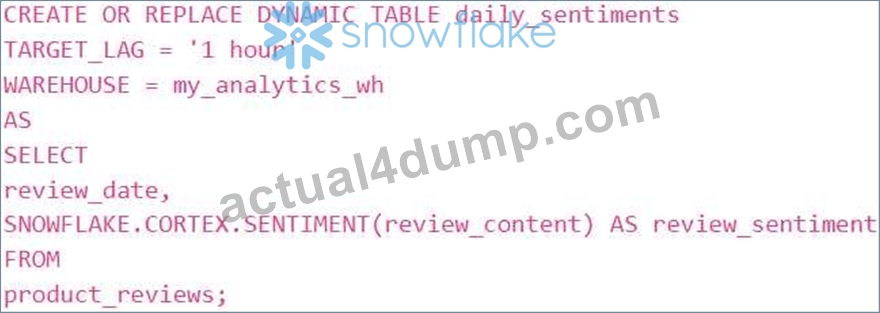
However, this operation fails. Which of the following is the most direct reason for the failure of this specific setup?
- A. The review_content column, if containing non-English text, would cause the SENTIMENT function to fail outright rather than produce inaccurate results.
- B. The TARGET_LAG for dynamic tables must be explicitly set to '1 day' or longer when integrating with Cortex functions.
- C. The warehouse my_analytics_wh is likely not a Snowpark-optimized warehouse, which is a requirement for Cortex functions within dynamic tables.
- D. The CORTEX_USER database role was not granted to the analyst's role, preventing the execution of Cortex functions.
- E. SNOWFLAKE. CORTEX. SENTIMENT and other Snowflake Cortex functions are currently incompatible with dynamic tables.
Answer: E
Explanation:
Option B is correct. Snowflake Cortex functions, including SNOWFLAKE .CORTEX. SENTIMENT, do not support dynamic tables. This is a fundamental limitation that would cause the CREATE DYNAMIC TABLE statement to fail when trying to incorporate a Cortex function. While the 'CORTEX_USER role is indeed required for calling Cortex AI functions, the direct failure in this scenario is due to the incompatibility with dynamic tables. Option C is incorrect as there's no specified TARGET_LAG' limitation. Option D is incorrect; Snowflake recommends using a smaller warehouse (no larger than MEDIUM) for Cortex functions, but a Snowpark-optimized warehouse is not a strict requirement, and larger warehouses do not increase performance. Option E is incorrect because 'SENTIMENT is designed for English-language input text, and non-English text would likely lead to unexpected or inaccurate results, not a direct failure of the function call itself.
NEW QUESTION # 33
A financial institution uses Snowflake Cortex Analyst with strict role-based access control (RBAC) on their Snowflake-hosted LLMs. The security team has granted specific 'CORTEX-MODEL-ROLE application roles to different analyst teams, ensuring they only access approved models. A new requirement arises to enable Azure OpenAI GPT models for Cortex Analyst to leverage a specific feature. An administrator proceeds to execute:
Which of the following statements accurately describe the implications of this change?
- A. Option E
- B. Option B
- C. Option A
- D. Option C
- E. Option D
Answer: B,D
Explanation:
Option B is correct because when is ' TRUE , cortex Analyst can use Azure OpenAI models, but this setting is incompatible with model-level RBAC, meaning RBAC is not available for any models used by Cortex Analyst when this parameter is enabled. Option C is correct because if Azure OpenAI models are opted in for Cortex Analyst, semantic model files (which are metadata) and user prompts will be processed by Microsoft Azure, a third party, thus transmitting them outside Snowflake's governance boundary. Customer data itself is not shared. Option A is incorrect because the parameter is incompatible with model-level RBAC for 'all' models used by Cortex Analyst. Option D is incorrect as the parameter specifically controls the use of Azure OpenAI models within Cortex Analyst. Option E is incorrect because this parameter can only be set by the ' ACCOUNTADMIN' role.
NEW QUESTION # 34
A Snowflake Gen AI Specialist is defining a semantic model for Cortex Analyst to improve text-to-SQL accuracy. They are adding entries to the verified _ queries section of their YAML file. Consider the following semantic model snippet and a proposed verified_query entry. Which of the following statements correctly identifies an issue or a best practice not followed in the sql field of the proposed verified_query entry, based on Cortex Analyst VQR guidelines? Semantic Model Snippet:
Proposed verified _ query entry:

- A. Option E
- B. Option B
- C. Option A
- D. Option C
- E. Option D
Answer: B,D
Explanation:
NEW QUESTION # 35
A developer is instrumenting a RAG application using the TruLens SDK within Snowflake AI Observability. The application has distinct functions for retrieving context and generating a completion. To ensure clear tracing and readability, which span_type should ideally be used for the function responsible for retrieving relevant text from the vector store?
- A.

- B.

- C. No specific span_type is needed; the default instrumentation is sufficient for all functions.
- D.

- E.

Answer: D
Explanation:
The TruLens SDK allows for specifying span_type to improve the readability and understanding of traces. For a RAG application, RETRIEVAL the span type is explicitly recommended for search services or retrievers (functions that retrieve context). GENERATION is used for LLM inference calls that generate answers, and RECORD_ROOT identifies the entry point method of the application.
NEW QUESTION # 36
An ML engineer is preparing a Docker image for a custom LLM application that will be deployed to Snowpark Container Services (SPCS). The application uses a mix of packages, some commonly found in the Snowflake Anaconda channel and others from general open-source repositories like PyPI. They have the following Docker-file snippet and need to ensure the dependencies are correctly installed for the SPCS environment to support a GPU workload. Which of the following approaches for installing Python packages in the Dockerfile would ensure a robust and compatible setup for a custom LLM running in Snowpark Container Services, based on best practices for managing dependencies in this environment?
- A.

- B.

- C.

- D.

- E.

Answer: E
Explanation:
Option B is correct. The provided Dockerfile example for deploying Llama 2 in Snowpark Container Services explicitly uses 'conda install -n rapids -c https://repo.anaconda.com/pkgs/snowflake' to install Snowflake-specific packages like 'snowflake-ml-python' and 'snowflake- snowpark-python' from the Snowflake Anaconda channel. It then uses 'pip install' for other open-source libraries that are not available or preferred from the Anaconda channels. Option A is incorrect because while pip can install many packages, the provided example demonstrates using 'conda' from the Snowflake Anaconda channel for certain foundational packages. Option C is incorrect because while 'conda-forge' is a common channel for open-source packages, the specific Snowflake-related packages in the example are pulled directly from the 'https://repo.anaconda.com/pkgs/snowflake' channel. Although Source notes that 'conda-forge' is assumed for 'conda_dependencies' in when building container images, a Dockerfile explicitly defining 'RUN conda install' can specify the channel, which the example in demonstrates. Option D is incorrect because the 'defaultS channel often requires user acceptance of Anaconda terms, which is not feasible in an automated build environment. Option E is a generic approach for pip dependencies but doesn't specifically address the recommended use of 'conda' from the Snowflake Anaconda channel for certain core Snowflake packages as shown in the practical example.
NEW QUESTION # 37
An enterprise is deploying a new RAG application using Snowflake Cortex Search on a large dataset of customer support tickets. The operations team is concerned about managing compute costs and ensuring efficient index refreshes for the Cortex Search Service, which needs to be updated hourly. Which of the following considerations and configurations are relevant for optimizing cost and performance of the Cortex Search Service in this scenario?
- A. The primary cost driver for Cortex Search is the number of search queries executed against the service, with the volume of indexed data (GB/month) having a minimal impact on overall billing.
- B. CHANGE_TRACKING
- C. For optimal performance and cost efficiency, Snowflake recommends using a dedicated warehouse of size no larger than MEDIUM for each Cortex Search Service.
- D. The

- E. For embedding text, selecting a model like

Answer: B,C,D,E
Explanation:
Option A is correct because a Cortex Search Service requires a virtual warehouse to refresh the service, which runs queries against base objects when they are initialized and refreshed, incurring compute costs. Option B is correct because the cost of embedding models varies. For example, 'snowflake-arctic-embed-m-v1.5 costs 0.03 credits per million tokens, while 'voyage-multilingual-2 costs 0.07 credits per million tokens. Choosing a more cost-effective model like 'snowflake-arctic-embed-m-v1.5 for English-only data can reduce token costs. Option C is correct because Snowflake recommends using a dedicated warehouse of size no larger than MEDIUM for each Cortex Search Service to achieve optimal performance. Option D is correct because change tracking is required for the Cortex Search Service to be able to detect and process updates to the base table, enabling incremental refreshes that are more efficient than full re-indexing. Option E is incorrect because Cortex Search Services incur costs based on virtual warehouse compute for refreshes, 'EMBED_TEXT_TOKENS' cost per input token, and a charge of 6.3 Credits per GB/mo of indexed data. The volume of indexed data has a significant impact, not minimal.
NEW QUESTION # 38
A team is planning the implementation of a new Document AI solution and needs to be aware of the specific guidelines and limitations concerning naming conventions and task management within Snowflake. A primary concern is to avoid common pitfalls that could lead to errors or unsupported configurations.
- A. Database and schema identifiers referenced in Document AI operations must not include double quotes, as this is an unsupported syntax.
- B. Document AI model builds can be renamed after their initial creation and publication to align with evolving project naming standards.
- C. For optimal cost management and to avoid resource contention, Document AI tasks should leverage serverless task configurations.
- D. Document AI supports concurrent user activity on the same model build in Snowsight, enabling multiple team members to upload documents and review answers simultaneously.
- E. While optional, creating a separate database and schema specifically for Document AI assets is a best practice for organization and cost visibility.
Answer: A,E
Explanation:
Option A is incorrect because DocumentAI does not currently support renaming models. Option B is incorrect as Document AI does not support serverless tasks. Option C is correct as Document AI does not support double quotes around identifiers for the database and schema. Option D is correct as Snowflake recommends creating a separate database and schema for Document AI to help track costs and manage objects. Option E is incorrect because Document AI does not support multiple users working on the same model build at the same time in Snowsight.
NEW QUESTION # 39
An ML engineer is developing a RAG application in Python and wants to use the TruLens SDK to trace the distinct phases of its execution, specifically the context retrieval and answer generation steps. They aim to clearly differentiate the tracing of the function responsible for retrieving context.
- A.

- B.

- C.

- D.

- E.

Answer: C
Explanation:
To instrument a function for context retrieval using the TruLens SDK and clearly differentiate its tracing, the decorator should be used with 'span_type=SpanAttributes.SpanType.RETRlEVAL'. This is directly demonstrated in the source for tracing a function with a specific span type. Option B uses a string literal for 'span_type' , which is not the correct way to reference the enum member. Option C uses 'SpanAttributes.SpanType.GENERATlON' , which is intended for LLM inference, not context retrieval. Option D uses the decorator without a specific 'span_type' , which would not clearly differentiate the context retrieval phase. Option E uses non- existent decorators and types(@trace_function', 'spanTypes').
NEW QUESTION # 40
A data engineer is setting up a Document AI pipeline to extract information from scanned invoices stored in an internal stage named 'invoice_stage'. They have created the stage using 'CREATE STAGE and uploaded several PDF documents. However, when attempting to run the extraction query, they encounter an error message: 'File extension does not match actual mime type. Mime- Type: application/octet-stream'. Additionally, they anticipate a privilege issue might arise for pipeline automation. Which of the following conditions must be met to resolve the current error and ensure proper setup for Document AI extraction and subsequent pipeline creation?
- A. Option E
- B. Option C
- C. Option D
- D. Option A
- E. Option B
Answer: B,D
Explanation:
NEW QUESTION # 41
......
GES-C01 Study Guide Cover to Cover as Literally: https://pass4sure.actual4dump.com/Snowflake/GES-C01-actualtests-dumps.html