

[May 13, 2024] Fully Updated MCD-Level-1 Dumps - 100% Same Q&A In Your Real Exam
Latest MCD-Level-1 Exam Dumps - Valid and Updated Dumps
NEW QUESTION # 129
Refer to the exhibits.
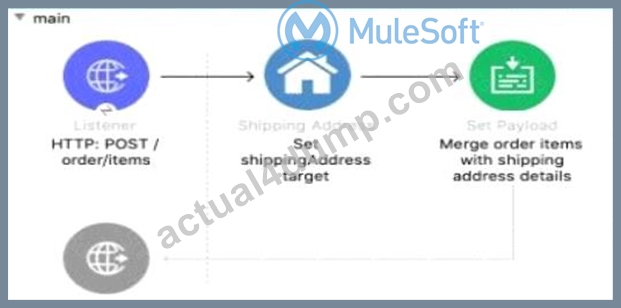
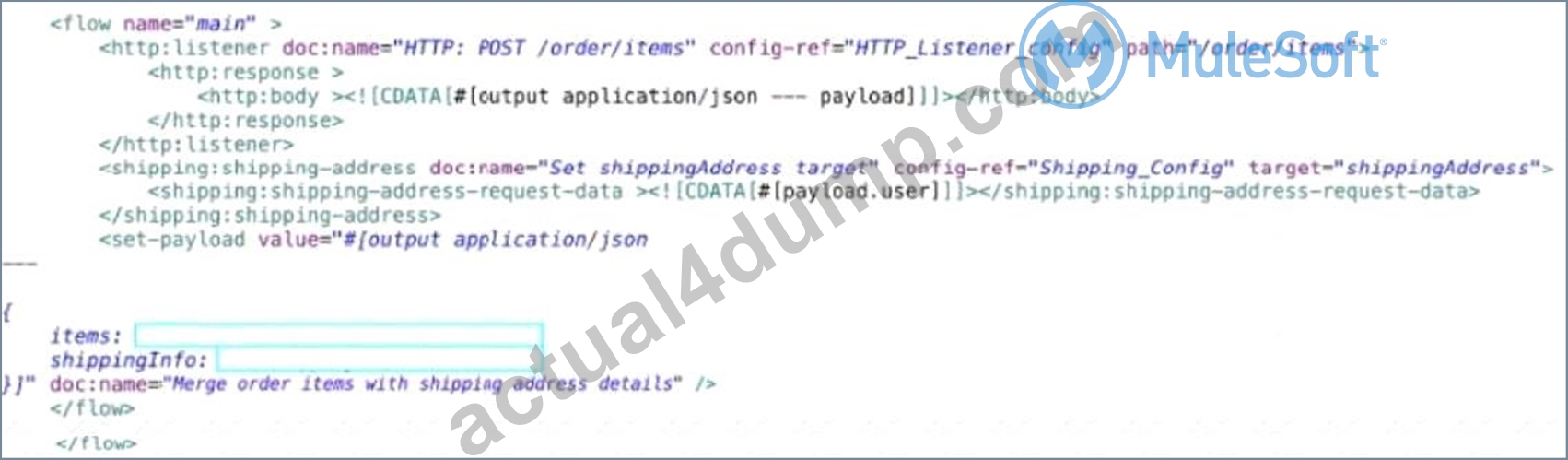
A Mule application is being developed to process web client POST requests with payloads containing order information including the user name and purchased items The Shipping connector returns a shipping address for the input payloads user name The Shipping connector's Shipping Address operation is configured with a target named shippingAddress.
The Set Payload transformer needs to set an item key equal to the items value from the original received payload and a shippinglnfo key equal to the the ShippingAddress operation's response What is a straightforward way to property configure the Set Payload transformer with the required data?
- A.

- B.
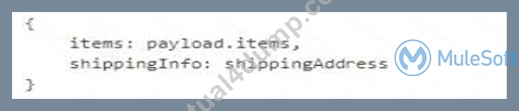
- C.

- D.

Answer: A
NEW QUESTION # 130
A RAML specification is defined to manage customers with a unique identifier for each customer record.
What URI does MuleSoft recommend to uniquely access the customer identified with the unique ID 1234?
- A. /customers?operation=get&custid=1234
- B. /customers/custid=1234
- C. /customers?custid=true&custid=1234
- D. /customers/1234
Answer: D
Explanation:
URI parameter (Path Param) is basically used to identify a specific resource or resources . For eg : the URL to get employee details on the basis of employeeID will be GET /employees/{employeeID} where employees is resource and {employeeID} is URI parameter. Hence option 1is the correct answer
NEW QUESTION # 131
Refer to the exhibits.

A web client sends a POST request to the HTTP Listener with the payload "Hello-". What response is returned to the web client?
What response is returned to the web client?
- A. HTTP-JMS2-Three
- B. Hello- HTTP-] MS2-Three
- C. Helb-JMS1-HTTP-JMS2 -Three
- D. Hello-HTTP-Three
Answer: B
NEW QUESTION # 132
Refer to the exhibits.

A Mule application contains a Choice router. What is logged when the flow completes?
- A. US
- B. EU
- C. "REGION"
- D. ["US", "EU"]
Answer: B
NEW QUESTION # 133
An app team is developing a mobile banking app. It took them two months to create their own APIs to access transaction information from a central database. The app team later found out that another team had already built an API that accesses the transaction information they need.
According to MuleSoft, what organization structure could have saved the app team two months of development time?
- A. Center for Enablement
- B. Center of Excellence
- C. MuleSoft Support Center
- D. Central API Review Board
Answer: A
Explanation:
Reference:
Center for Enablement is correct answer .It is a cross-functional team typically staffed with members from central IT, line-of-business departments, and digital innovation teams charged with productizing, publishing, and harvesting reusable assets and best practices. In this case , app team would have checked first with Center for Enablement before developing their own API's. Hence could have avoided re-work
NEW QUESTION # 134
Refer to the exhibit.
What is the response to a web client request to http://localhost:8081?
- A. before
- B. After
- C. null
- D. Validation Error
Answer: D
Explanation:
NEW QUESTION # 135
Refer to the exhibits.
What payload and variable are logged at the end of the main flow?
- A. [[5, 10, 15, 20], 5]
- B. [Req5Req10,Req15Req20, 5]
- C. [[Req5, Req10, Req15, Req20], 5]
- D. [[5, 10, 15, 20], 1]
Answer: A
Explanation:
Correct answer is [[5, 10, 15, 20], 5]
Key thing to note here is that any changes made to payload in for each loop are not available outside for each scope where as variable value updated in for each loop is visible out side for each loop too.
In this example , sequence can be described as follows
1) Payload is set to the value [5, 10, 15, 20]
2) Variable is set to the value of 1
3) For each loop is executed four times and in each loop payload value is updated to append "Req" and variable is count is increased by 1
4) Once control comes out of for each , payload changes made within for each are not visible. Hence payload at this point of time is equal to payload available before entering for each loop which was [5, 10, 15, 20].
Similarly variable value updated in for each loop is also available outside hence variable value is 5 as it was updated in loop.
5) Hence correct answer is [[5, 10, 15, 20], 5]
For Each Scope
The For Each scope splits a payload into elements and processes them one by one through the components that you place in the scope. It is similar to a for-each/for loop code block in most programming languages and can process any collection, including lists and arrays. The collection can be any supported content type, such as application/json, application/java, or application/xml.
General considerations about the For Each scope:
By default, For Each tries to split the payload. If the payload is a simple Java collection, the For Each scope can split it without any configuration. The payload inside the For Each scope is each of the split elements.
Attributes within the original message are ignored because they are related to the entire message.
For Each does not modify the current payload. The output payload is the same as the input.
For non-Java collections, such as XML or JSON, use a DataWeave expression to split data. Use the Collection field for this purpose.
NEW QUESTION # 136
An API was designed in API Designer, published to Anypoint Exchange, then imported into API Manager.
A Mule application implements this API and is deployed to CloudHub. API Manager manages this deployed API implementation.
What is the easiest and most idiomatic (used for its intended purpose) way to enforce a Client ID Enforcement policy on this Mule application?
- A. In Anypoint Studio, code a custom policy tor Client ID Enforcement and then add the custom policy to Runtime Manager for the Mule application deployment
- B. In API Designer, add Client ID Enforcement policy requirements to the API specification
- C. In API Manager, apply a Client ID Enforcement policy for the API instance
- D. In Anypoint Design Center, code a custom policy for Client ID Enforcement and then publish the custom policy to the API portal in Anypoint Exchange
Answer: C
NEW QUESTION # 137
What asset cannot be created using Design Center?
- A. API portals
- B. API specifications
- C. API fragments
- D. Mule Applications
Answer: A
Explanation:
API portal are created by API Exchange and cannot be created by Design Center
NEW QUESTION # 138
An API instance of type API endpoint with API proxy is created in API manager using an API specification from Anypoint Exchange. The API instance is also configured with an API proxy that is deployed and running in CloudHub.
An SLA- based policy is enabled in API manager for this API instance.
Where can an external API consumer obtain a valid client ID and client secret to successfully send requests to the API proxy?
- A. In Anypoint Studio, from components generated by APIkit for the API specification
- B. In Runtime Manager, from the properties tab of the deployed approved API proxy
- C. In Anypoint Studio, from components generated by Rest Connect for API specification
- D. In the organization's public API portal in Anypoint Exchange, from an approved client application for the API proxy
Answer: D
Explanation:
* When a client application is registered in Anypoint Platform, a pair of credentials consisting of a client ID and client secret is generated.
* When the client application requests access to an API, a contract is created between the application and that API.
* An API that is protected with a Client ID Enforcement policy is accessible only to applications that have an approved contract.
--------------------------------------------------------------------------------------------------------------------------------------------- Correct answer: In the organization's public API portal in Anypoint Exchange, from an approved client application for the API proxy
NEW QUESTION # 139
Refer to the exhibit.
What data is expected by the POST /accounts endpoint?
A)
B)
C)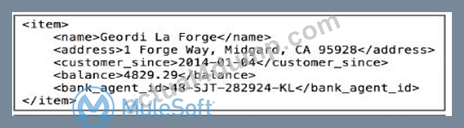
D)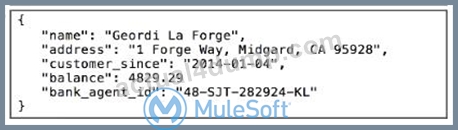
- A. Option B
- B. Option D
- C. Option A
- D. Option C
Answer: B
NEW QUESTION # 140
A company has an API to manage purchase orders, with each record identified by a unique purchase order ID. The API was built with RAML according to MuleSoft best practices.
What URI should a web client use to request order P05555?
- A. /orders/P05555
- B. /orders/order=P05555
- C. /orders/{P05555}
- D. /orders?order=P05555
Answer: A
NEW QUESTION # 141
Refer to the exhibits. A company has defined this Book data type and Book example to be used in APIs. What is valid RAML for an API that uses this Book data type and Book example?
A)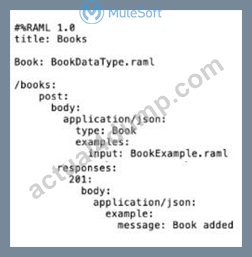
B)
C)
D)
- A. Option B
- B. Option D
- C. Option A
- D. Option C
Answer: B
NEW QUESTION # 142
Refer to the exhibits.
The orders.csv file is read, then processed to look up the orders in a database. The Mule application is debugged in Any point Studio and stops at the breakpoint.
What is the payload shown in the debugger at this breakpoint?
- A. The database response
- B. 0
- C. "none"
- D. The entire CSV file
Answer: B
NEW QUESTION # 143
A company has defined two RAML fragments, Book Data Type and Book Example to be used in APIs.
What would be valid RAML to use these fragments ?

- A. 1. #%RAML 1.0
2. title: Books
3. types:
4. Book: ABC/Examples/bookDataType.raml
5. /books:
6. post:
7. body:
8. application/json:
9. type: Book
10. examples:
11. input: ABC/Examples/bookExample.raml
12. responses:
13. 201:
14. body:
15. application/json:
16. example:
17. message: Book added - B. 1. #%RAML 1.0
2. title: Books
3. Book: bookDataType.raml
4. /books:
5. post:
6. body:
7. application/json:
8. type: Book
9. examples:
10. input: bookExample.raml
11. responses:
12. 201:
13. body:
14. application/json:
15. example:
16. message: Book added - C. 1. #%RAML 1.0
2. title: Books
3. Book: !include bookDataType.raml
4. /books:
5. post:
6. body:
7. application/json:
8. type: Book
9. examples:
10. input: !include bookExample.raml
11. responses:
12. 201:
13. body:
14. application/json:
15. example:
16. message: Book added - D. 1. #%RAML 1.0
2. title: Books
3. Book: bookDataType.raml
4. /books:
5. post:
6. body:
7. application/json:
8. type: Book
9. examples:
10. input: bookExample.raml
11. responses:
12. 201:
13. body:
14. application/json:
15. example:
16. message: Book added
Answer: D
Explanation:
* RAML file contains lot of information that could be considered as "not API-describing". Sort of "economy-class" members.
Equally important, but not necessarily part of the main RAML file.
* Through !includes, RAML allows us to build file-distributed API definitions, which is not only useful to encourage code reuse but also improves readability.
* We can create RAML fragments with such code and then include them in main RAML project using !include like:
types:
Book: !include bookDataType.raml and
examples:
input: !include bookExample.raml
* Additionally for
---------------------------------------------------------------------------------------------------------------------------------------- Correct answer: D
NEW QUESTION # 144
A Mule application contains an ActiveMQ JMS dependency. The Mule application was developed in Anypoint Studio and runs successfully in Anypoint Studio.
The Mule application must now be exported from Anypoint Studio and shared with another developer.
What export options create the smallest JAR file that can be imported into the other developer's Anypoint Studio and run successfully?
- A. Option B
- B. Option D
- C. Option A
- D. Option C
Answer: B
NEW QUESTION # 145
......
MuleSoft MCD-Level-1 Certification Exam is an excellent way for developers to demonstrate their knowledge and skills in using the MuleSoft platform. By passing MCD-Level-1 exam, individuals can enhance their career prospects and become recognized as experts in the field of application development using MuleSoft.
Free Sales Ending Soon - 100% Valid MCD-Level-1 Exam: https://pass4sure.actual4dump.com/MuleSoft/MCD-Level-1-actualtests-dumps.html